

Cost Optimisation & Efficiency
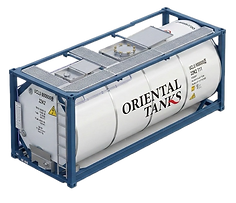
Cost optimisation in liquid logistics is often misunderstood. Too much focus is placed on the visible upfront cost of packaging, while the broader operational impact is ignored.
At Oriental Tanks, we look at efficiency the way manufacturers and logistics planners experience it in practice: through throughput, residue, labor, heating time, cargo recovery, freight utilization, and the ability to keep production moving without disruption.
That is why ISO tanks consistently outperform disposable transport formats over the long term. They do not just lower one cost line. They improve how the entire movement process functions.
Optimised Cost Through Efficiency
More Payload Per Shipment
A straightforward advantage of ISO tanks is higher carrying efficiency. Studies show that in a standard 20-foot container footprint, ISO tanks can carry an average of 24,000L compared to around 15,000L in drums, representing roughly 60 percent more liquid volume per TEU. That additional payload matters. It reduces the number of units needed to move the same volume, improves freight productivity, and lowers the operational drag associated with handling smaller, fragmented packaging systems.
For customers moving regular volumes across regional or global lanes, this directly supports better transport economics and more efficient inventory flow.
Lower Hidden Costs Than Disposable Alternatives
Alternatives such as flexibags, carton boxes, and bag-in-box systems are often selected because they appear cheaper at first glance. But it is clear that once disposal, heating inefficiency, residue, manpower, re-liquefaction, storage, packaging waste, and operational disruption are taken into account, those savings quickly erode, even becomes a serious liability.
ISO tanks remove many of those hidden burdens. There is no recurring cost of disposable liners and associated waste handling after each trip. Cleaning is part of the reusable asset cycle. Loading and discharge are more straightforward. Heating is more efficient. Residue is lower. Labor intensity is reduced.
That combination is what turns logistics from a recurring cost center into a more optimized supply chain function.
Faster Heating, Reliable Cooling, Faster Turnaround
Thermal performance is a major driver of efficiency for viscous, solidifying, or temperature-sensitive cargo. The sustainability study shows that ISO tanks use built-in stainless steel heating channels welded to the shell, enabling more efficient heat transfer and allowing much higher steam temperature than flexibag heating pads, which are constrained by rubber material limitations and poorer conductivity.
In practice, this means faster heating, more even temperature distribution, and less time lost waiting for cargo to reach discharge condition. ISO tanks are also insulated to retain heat more effectively, reducing reheating effort and helping maintain product condition across the transport cycle.
For the receivers, the benefit is measurable: shorter discharge preparation, lower utility consumption, more reliable production scheduling, and less downtime at the point of use.
Reduced Residue, Higher Product Recovery
Efficiency is not only about what arrives. It is also about what can actually be discharged and used. Studies reveal that up to 5 percent, or around 1,200L, may be left as residue in flexitbags and other mediums, making them less suitable, especially for expensive liquids.
ISO tanks improve product recovery through better discharge design, improved thermal control, and more complete unloading. That means more saleable or usable cargo reaches the customer’s process rather than remaining trapped in packaging, wasted as residue, or lost during discharge. When the liquid being transported is of high-value, the economics of better recovery become even more compelling.
Lower Labor Burden and Simpler Operations
Disposable systems often shift work downstream. They require more setup, more dismantling, more manual handling, and more cleanup. Fexibags and BIB systems are labor-intensive, inducing the need for pre-loading preparation, post-discharge teardown, confined-space entry, and manual efforts to extract residue of up to 1200L.
ISO tanks simplify these steps. With dedicated valves, integrated systems, and purpose-designed handling, operations become more controlled and repeatable. This reduces labor exposure, lowers the chance of human error and potential hazards, and improves turnaround time throughout the shipment cycle.
Real Savings, Not Just Theoretical Gains
A case study example of a coconut water producer moving 150MT per day using 1MT IBCs with disposable inner bags realised a cost savings of approximately USD200,000 per month after switching from IBCs to ISO Tanks, with added benefits from zero leakage, reduced waste, and dramatically lowered labour, storage, and transport inefficiencies.
The specifics of each product and route will differ, but the broader principle is consistent. When evaluating the total landed logistics cost rather than just packaging price, ISO tank container solutions emerge as the stronger commercial choice.
Optimisation Through Better Tank Solutions
At Oriental Tanks, efficiency is not limited to standard tank deployment. It also extends into custom engineering solutions tailored to cargo behaviour and operational bottlenecks. We stand out in the industry by leveraging our expertise in innovative solutions to optimise the efficiency of your product lifecycle from start to finish. Examples include reefer tanks, hygienic CIP-equipped tanks, electrically heated tanks, jumbo tanks, ultra-insulated tanks, chocolate tanks, milk tanks and other tanks specifically designed for your cargo.
These are not add-ons for appearance. They are tools for eliminating inefficiency at source. Whether the challenge is heat loss, long discharge cycles, residue, temperature precision, or payload limitation, the right tank specification can materially improve your supply chain performance.
Efficiency With Long-Term Value
At Oriental Tanks, we believe cost optimisation should not come from compromise. It should come from using better systems that increase payload, reduce waste, shorten handling time, improve product recovery, and support safer, cleaner operations.
For us, efficiency is not just a metric. It is part of a broader commitment to reliability, trust, and long-term relationships with every customer we serve.
Why Choose Oriental Tanks
Choosing Oriental Tanks means partnering with a team that genuinely understands the sensitivity of food-grade logistics. Our commitment to safety and hygiene is not just a checkbox, it is embedded in our operations, our fleet strategy, and our company mindset.
We don’t adapt general-purpose tanks for food transport. We dedicate, maintain, and operate them specifically for it.
Because when it comes to food and beverage cargo, there is no room for compromise, and we make sure there never is.
